Backflow Testing for Businesses: What It Is and Why It Is Required
Backflow testing is the annual check of the backflow prevention assemblies that stop contaminated water from flowing backward into the public drinking water supply. Businesses in Diamond Bar with irrigation systems, soda and ice machines, boilers, fire sprinkler lines or other cross connections are typically required to have these assemblies tested once a year by a certified tester, with the results reported to the water agency.
Calls are answered 24/7 and may be recorded for quality and lead verification.
Every building that connects to the public water supply has one line coming in and the assumption that water only flows one way: into the building. Backflow is what happens when that assumption breaks. A pressure drop in the main, a fire hydrant opened down the street, or a booster pump inside the building can reverse the flow and pull water from a business back into the city supply. If that water has picked up chemicals, fertilizer, boiler treatment or carbonated soda along the way, it contaminates the drinking water for everyone on the line. Backflow prevention assemblies are the mechanical devices that make that impossible, and backflow testing is how you prove they still work. For businesses across Diamond Bar, from restaurants on Diamond Bar Boulevard to medical and office buildings near the 57 and 60 junction, the test is not optional. It is a yearly obligation.
What backflow actually is, in plain language
Normally, the pressure in the public water main is higher than the pressure inside your building, so water flows inward. Backflow happens when that relationship flips, and it flips in two ways. The first is back pressure: your building's pressure exceeds the main's, for example when a boiler, booster pump or elevated tank pushes harder than the street supply. The second is backsiphonage: the main loses pressure suddenly, often from a water main break or a fire hydrant opened nearby, and the vacuum that forms literally sucks water out of the connected buildings. The hazard is the same either way. Water that was clean when it entered your building can come back out carrying whatever it touched inside: fertilizer from an irrigation line, cleaning chemicals from a mop sink, carbon dioxide from a soda machine, or treated water from a boiler. This is why backflow prevention is a public health measure, not a plumbing upgrade. One failed connection can affect a whole street.
Which Diamond Bar businesses usually need backflow assemblies
The rule of thumb is simple: if your building connects anything to the drinking water that could contaminate it, you need a backflow assembly at that connection. In Diamond Bar's commercial landscape, the common cases are restaurants and food outlets with soda machines, ice machines and dishwashers; properties with landscape irrigation systems, especially those using fertilizer injection or reclaimed water connections; car washes and auto detail shops with chemical injection; medical and dental offices with equipment connected to the water supply; and buildings with boilers, cooling towers or fire sprinkler systems. Strip centers and retail buildings often have several of these connections at once, one for the irrigation, one for the fire line, one for each food tenant. Each assembly has to be tested. A commercial property owner who assumes the tenants handle it, while each tenant assumes the owner handles it, is the most common way testing gets missed. If you are not sure which connections your building has, have a provider survey the site.
Why the test is required every year
Backflow assemblies are mechanical devices with springs, check valves and seals, and they wear out. A seal that held last year can weaken, a spring can fatigue, debris can keep a check valve from closing fully. There is no visible sign of failure, which is exactly the problem: a failed assembly looks identical to a working one until the day it is needed. California's public water system rules require backflow prevention on higher hazard connections, and the water agencies that serve Los Angeles County typically require these assemblies to be tested once a year by a certified tester, with results reported to the agency. Many agencies also send reminder notices to the address on file, but the notice going to an old address or a previous owner does not remove the obligation. The requirement follows the connection, not the paperwork. For a broader look at the services commercial properties in the city typically need, see our commercial plumbing page.
What a backflow test visit actually involves
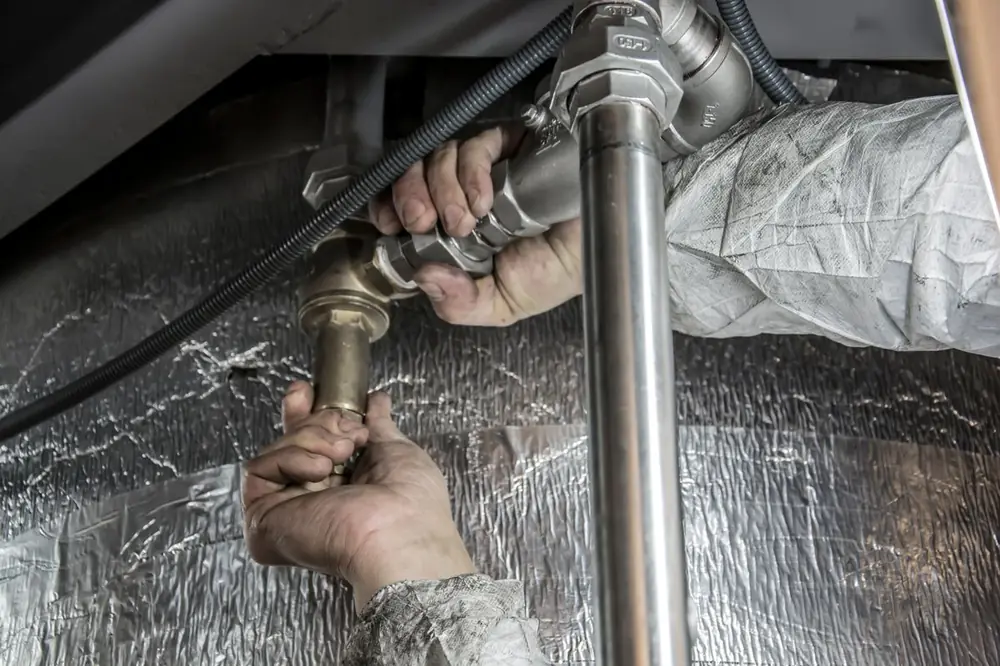
A certified tester arrives with a calibrated gauge and works through each assembly on the property. For each device, they shut off the water to the device, connect the test gauge to the test ports, and run a sequence of pressure readings that verify each check valve holds and opens at the correct pressure. The whole sequence takes well under an hour per device for standard assemblies. Afterward, the tester fills out the test report with the readings, notes any deficiency, and submits it to the water agency, usually within a set number of days. You should receive a copy for your own records. The water interruption during the test is brief and limited to the device being tested, but it is worth warning staff, especially in restaurants, so nobody is mid dishwash when a sink loses water for a few minutes. Testing is also often done in pairs with other annual commercial work, since the same provider visit can cover the building's other yearly plumbing tasks. Our commercial plumbing services for Diamond Bar businesses cover backflow testing alongside those yearly tasks. Our gas line services page covers backflow assembly installation and testing as one of the services available to commercial properties in Diamond Bar.
What a failed test means for your business
A failed test is not a fine, and it is not an emergency, but it does start a clock. The report tells the water agency that the assembly does not meet the required pressure readings, and the agency typically gives the property a set period to repair or replace the assembly and submit a passing retest. The repair itself is usually straightforward: replacing worn check valves, springs or seals, or in some cases swapping in a new assembly if the body is damaged or the device is obsolete. After the repair, the tester runs the test again and files the passing report. Do not ignore a failed test. An unresolved failure can escalate from a notice to a requirement that water service to the connection be interrupted until the assembly passes. For a restaurant, that means no water, which means no operation. The cost factors are the number of assemblies, their condition and accessibility, and whether any excavation or piping changes are needed around them. None of that is a surprise when the test is done on schedule, because the problem is found while it is still small.
Building backflow into your yearly routine
The businesses that never have a backflow problem are the ones that never let the test lapse. Put the test on the same annual calendar as your other building obligations, and assign one person to it so the responsibility does not drift between a property manager, a tenant and a vendor. Keep every year's passing report with your other compliance records, since a new property manager or tenant will eventually need to show the history.
Getting your test scheduled
Call (909) 363-3380 and describe your property: the type of business, the number of backflow assemblies if you know it, and when the last test was done. Your call is routed to an available local licensed provider experienced with Diamond Bar commercial properties, who can survey the connections, test the assemblies with calibrated equipment, and file the reports your water agency needs. Calls are answered 24/7, and may be recorded for quality and lead verification.
Is your annual backflow test due?
Connect with a certified local provider to test your assemblies and keep your compliance records current.
Call (909) 363-3380Calls answered 24/7. Calls may be recorded for quality and lead verification.