Dripping Faucet: When a Washer Fixes It and When It Will Not
A washer replacement fixes a dripping faucet only in compression faucets, the older two-handle style where a washer seals against a seat. Single-handle cartridge, ball, and disc faucets have no washer to replace. In Diamond Bar, hard water corrodes seats and kills repeat washer jobs. A local licensed provider can say whether a repair will hold or replacement is smarter.
Calls are answered 24/7 and may be recorded for quality and lead verification.
A dripping faucet is one of those sounds that is easy to ignore during the day and impossible to ignore at night. The good news is that some drips really are a simple fix: a small washer or a worn part that anyone can replace. The bad news is that not every drip is that kind of problem, and repeating a washer replacement on the wrong faucet is a classic way to waste a Saturday. This guide explains the two families of faucets in plain language, what a washer replacement actually fixes, what it cannot fix, and how Diamond Bar's hard water changes the math on repair versus replacement.
The two faucet families
Almost every faucet in a home belongs to one of two designs, and knowing which one you have tells you whether a washer fix even applies. Look at how the handles work before you buy any parts.
Compression faucets: the classic older style
Compression faucets are the older design: separate hot and cold handles that you turn several times to open and close. Inside each handle, a stem presses a rubber washer down onto a metal seat to stop the flow. Tightening the handle squeezes the washer harder against the seat. If you have a two-handle faucet that needs a firm twist to fully stop dripping, it is almost certainly a compression faucet.
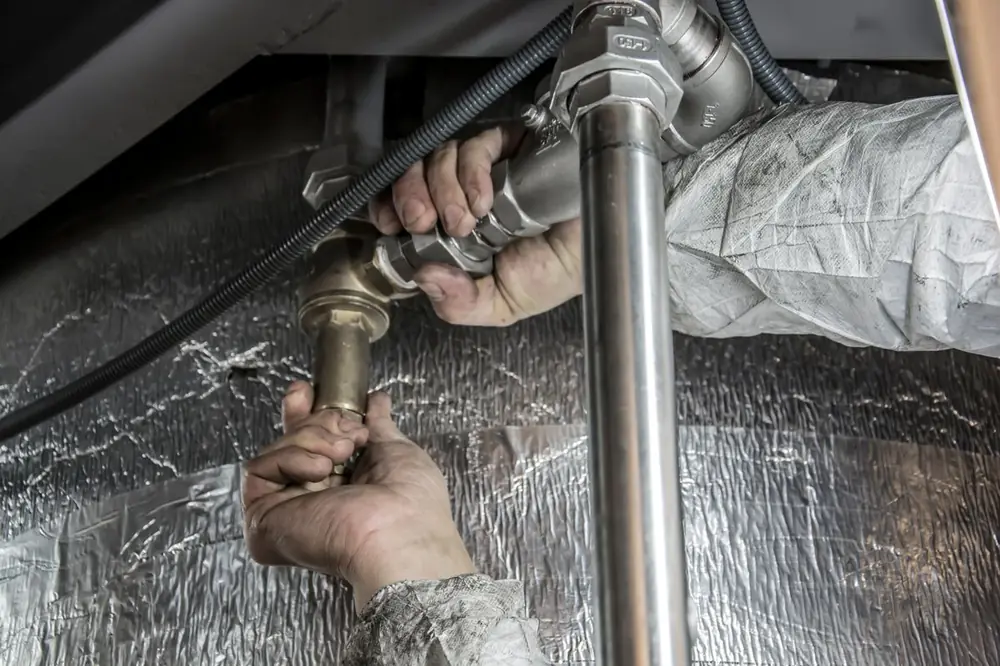
These are the faucets where washer replacement is a real fix. The washers wear down from the constant squeezing, develop grooves, and eventually let water past, which is why the drip starts gradually and gets worse. Swapping in a fresh washer, and sometimes the small O-ring on the stem, restores the seal. It is a cheap part and a straightforward job for anyone comfortable with basic tools, as long as you can identify the right washer size.
Cartridge, ball, and disc faucets: the newer single-handle styles
Most newer faucets use a single handle that moves up and down or side to side, and they work on a completely different principle. Instead of a washer being squeezed onto a seat, a cartridge, ball, or ceramic disc inside the body controls the flow. These parts are designed to last longer and they do not use a classic washer at all.
That means a washer replacement does not apply here. If a single-handle faucet drips, the fix is to replace or rebuild the cartridge or the equivalent internal part for that model. Many manufacturers sell a matching repair kit, and for common models the job is not much harder than a washer swap. The key step is identifying the faucet brand and model so you get the right kit, because these parts are not interchangeable the way basic washers are.
What a washer replacement actually fixes
A washer replacement fixes one specific problem: a drip from the spout of a compression faucet caused by a worn washer. If the drip stops when you tighten the handle extra hard, or it started as an occasional drop and grew into a steady drip, a fresh washer is very likely the answer. Replacing the washer plus the stem O-ring at the same time is good practice, since the O-ring is usually the same age and costs almost nothing.
This is a genuinely simple fix with basic hand tools and the water shut off at the valves under the sink. Take the old washer with you to match the size exactly, because a washer that is slightly off will not seal and will fail again quickly.
What a washer cannot fix
A washer is only as good as the surface it seals against. Here is what a new washer cannot solve:
- A corroded or pitted seat. The metal seat the washer presses against can develop pits, grooves, or mineral crust. A fresh washer pressed against a damaged seat still leaks. Some seats can be smoothed with a seat wrench or replaced; some cannot.
- A worn cartridge or disc. In single-handle faucets there is no washer to replace. A drip here needs the cartridge or the internal mechanism rebuilt or replaced.
- Leaking at the handle base. Water seeping around the base of the handle or under the spout usually points to worn O-rings or seals, not the main washer.
- A cracked body or spout. No washer fixes a crack. If the faucet body itself is damaged, the faucet needs replacing.
- A drip that returns within weeks. If a new washer fixes the drip and it comes back quickly, the seat is likely damaged or the wrong size washer was used. Repeating the same repair will not change the result.
Why Diamond Bar faucets fail faster
Diamond Bar's hard water is the underlying cause of a lot of repeat faucet problems. Mineral-rich water leaves scale on seats, pits the metal over time, and turns washers brittle sooner. A washer that might last years in a soft-water home can fail much sooner here, and the seat it seals against degrades faster too. This is why a drip that keeps coming back after fresh washers is so common in Diamond Bar: the washer was never the whole problem. If hard water is eating through your fixtures, our water treatment page explains the options for protecting the plumbing in your home.
When replacement beats another repair
There comes a point where fixing the old faucet costs more in time and parts than it is worth. Consider replacement when the faucet is old enough that parts are hard to find, the finish is worn or corroded, the seat is damaged beyond repair, or the same drip has returned after two fresh washers. A new faucet also brings updated water efficiency and a fresh finish, and the install is straightforward for a matched local provider.
Cost factors, not prices, are what decide this: the availability of parts for your model, how accessible the faucet is under the sink, whether shutoff valves work or also need replacing, and how much hard water damage the body shows. If you are unsure which side of the line your faucet falls on, a provider can look at it during a fixture repair visit and tell you honestly whether a repair will hold.
When to call instead of DIY
Call to be matched with a local licensed provider when the shutoff valves under the sink do not fully stop the water, when the faucet is corroded in place and will not come apart, when the drip is coming from inside the wall or under the sink cabinet, or when you have already tried the washer route and the drip is back. Stripped threads, broken supply lines, and water damage inside a cabinet all turn a simple fix into something bigger. Our fixture repair and installation page covers what a matched provider handles on a typical visit.
Stop the drip for good
A dripping faucet is small until you count the wasted water and the sleep it costs you. If you would rather have it diagnosed and fixed properly the first time, call (909) 363-3380 and you will be matched with a local licensed provider who can repair or replace the faucet and make sure the fix holds. Calls are answered 24/7 and may be recorded for quality and lead verification.
Tired of the drip?
Call once and get matched with a licensed local provider who can tell you whether a repair will hold or a new faucet is smarter.
Call (909) 363-3380Calls answered 24/7. Calls may be recorded for quality and lead verification.